An arts education at Michigan State University goes beyond two dimensions. Students have opportunities to participate in fabrication, metal casting, and sculpture experiences with their peers at MSU and around Michigan — all while wearing proper safety gear of course.
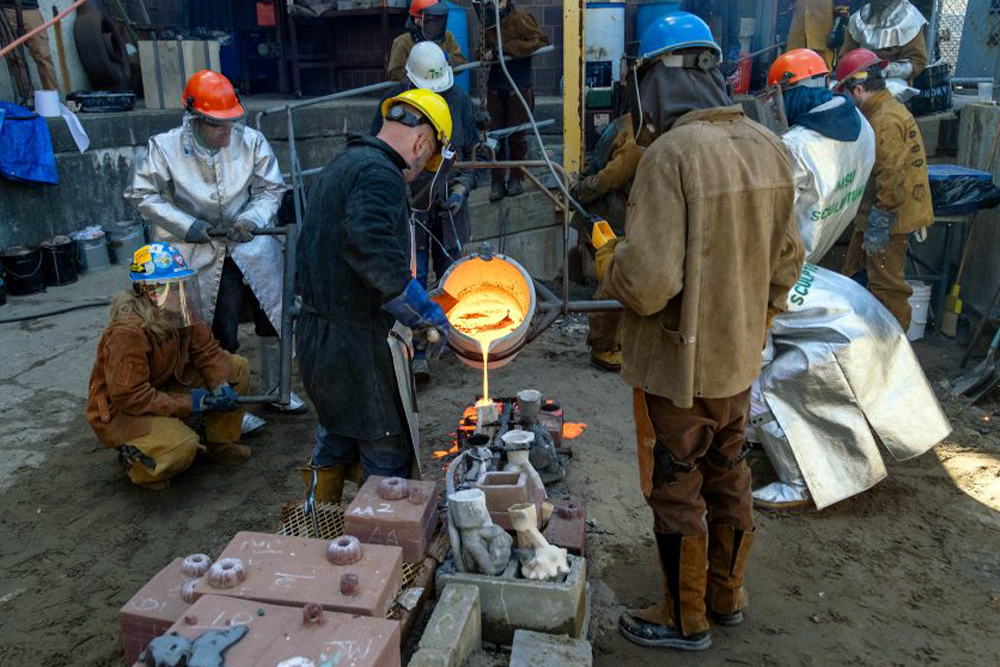
MSU Assistant Professor of Sculpture Jamie Weinfurter teaches casting, sculpture, and introductory art courses in the MSU Department of Art, Art History, and Design (AAHD). In these courses, students learn the artistic process of metal casting, which involves heating a metal to its molten state and then pouring the liquid into a mold to solidify a specific shape.
“Hands-on experience — demonstrations, everything — is so important to sculpture and to art making itself so that students can actually have those hands-on skills to be able to know how to do this process after they attend MSU and when they go off to work as professional artists,” Weinfurter said.
Metalworking Community
In metalworking, the types of molds and metal pouring processes differ based on the types of metal used. MSU’s metal casting facilities in the Kresge Art Center can accommodate aluminum and bronze, but not iron, which has a much higher melting point.
To learn more about the process of working with iron, 14 students and faculty from MSU participated in the 40th Annual Iron Pour in March at the College for Creative Studies (CCS) in Detroit, Michigan. CCS also invited faculty and students from Cranbrook Art Academy, the University of Michigan, and Wayne State University to be a part of this community-focused metal pouring event.


“An iron pour is a specific and very unique experience because the iron itself needs to get up to a much higher melting point in order for it to reach its liquid state,” Weinfurter said. “It’s very different than aluminum and bronze casting that we can do at Michigan State, so it’s nice to be able to give students a broader understanding of what’s possible in metal casting.”
The CCS Metalshop and Foundry has a long-standing legacy in metal casting and as an artistic and educational hub in Detroit and around Michigan.
“For this 40th anniversary, the iron pour was explicitly opened to anyone with casting and foundry experience from outside the college, turning it into a true ‘art and craft-community reunion,’” said Nikki Barbour, Director of Academic Facilities at CCS.


“Iron pours are always collaborative and community-driven events as they are so labor and time intensive — from building and maintaining the cupola [furnace], to gathering all the materials necessary, to making the work and having enough molds to pour — it really takes a group of crazy individuals who love the process,” Barbour said.
She added that it’s important to CCS to include other students and colleagues from Michigan colleges and universities because it’s a chance to work together as a growing community of artists. It also reinforces the state’s industrial and automotive history and connection to creative Michiganders.
“It fosters camaraderie across Michigan’s art scene and introduces our students and community to like-minded students, faculty, and artists across the region, creating experiences and connections that in some cases last a lifetime,” Barbour said.


Supporting Student Experiences
MSU undergraduate and graduate students were able to participate in the CCS Iron Pour in part through a grant from the MSU College of Arts and Letters which covered mold-making supplies and travel costs to Detroit. These types of experiential learning and networking opportunities outside of class help prepare students for future residencies and careers.
Evan Yalowitz, an MSU Studio Art student and recent graduate, had opportunities to gain experience in metal casting at aluminum and bronze pours on campus and at the CCS Iron Pour in Detroit.
“Hands-on learning is super important, especially in the arts,” she said. “There’s only so much that you can learn through lectures and through seeing it with your eyes. Actually getting in and getting your hands dirty is extremely important to the process.”


Yalowitz helped prepare the molds in advance of the iron pour and was excited to learn a new metal casting process at CCS.
“When we’re doing bronze or aluminum, we load the crucible while it’s sitting in the furnace,” she said. “With iron, we’re loading the furnace, but then the crucible is catching the metal with the furnace as it comes shooting out, which is crazy but also so cool and awesome.”
Additionally, Yalowitz presented sculptural work from the iron pour at MSU’s University Undergraduate Research and Arts Forum in April receiving first place in the Visual Art Showcase for her project.
MSU Ceramics Instructor Mackenzie Sheehan-D’Arrigo said the iron pour was an adrenaline rush as well as a unique opportunity to participate in a different metal casting process with a creative community.
“Metal pours help teach students good, clear communication. It’s a stressful environment. It’s fast paced. It’s dangerous. You need to be really clear, really concise,” she said. “You have to be so present. You have to be so in tune with your body, but also aware of what’s going around you, who is around you, how they’re moving.”


Sheehan-D’Arrigo received her Bachelor of Fine Arts degree in Studio Art from MSU in 2024 and takes a lot of those foundational experiences into her teaching.
“Hands-on activities are important in the arts because they help build confidence through hand, body, and mind connection. It’s kind of like transferring energy,” she said. “It’s one thing to learn the technique, but another thing to learn to do it.”
Future Metal Casting Opportunities at MSU
Access to metal casting opportunities at MSU will increase in the next year through support from the College of Arts and Letters Engaged Pedagogy and Programming Fund.
Weinfurter and Laurén Gerig, Assistant Professor and Director of Galleries and Outreach in AAHD, will bring metal casters to MSU during April 2027 to exhibit their work in the MSU Union Gallery, talk with students and the community about their art and career paths in sculpture, and participate in an iron pour on campus.
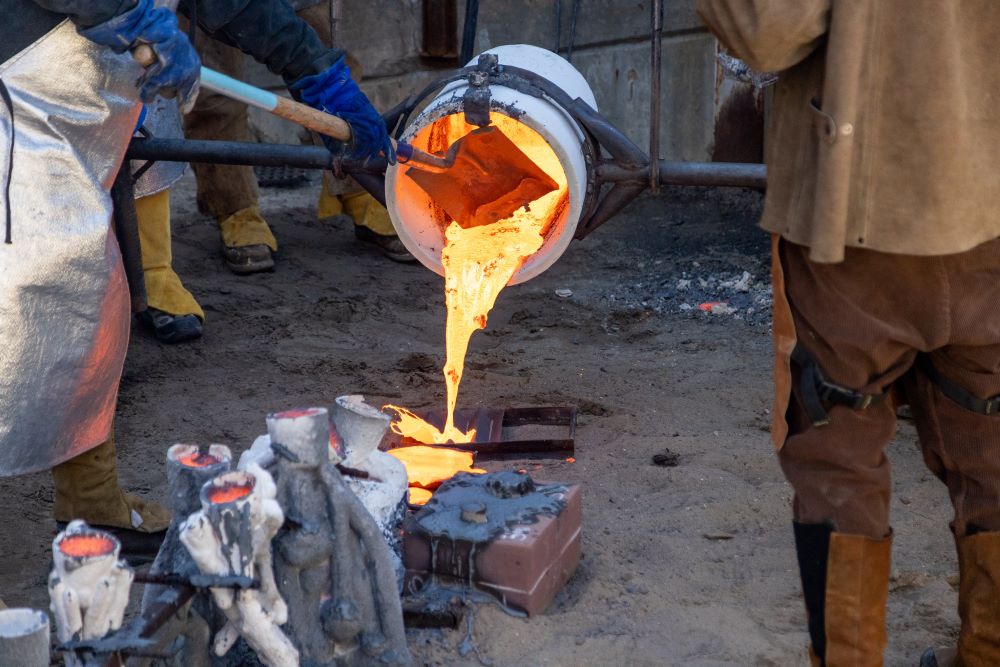
“A goal of the MSU Sculpture Program and Department of Art, Art History, and Design is to grow and strengthen the network of artists from universities across Michigan to give students more opportunities, connections, and hands-on experience while working with other major universities,” Weinfurter said. “These events provide a community-engaged mold making and large-scale casting experience that otherwise would not be possible at MSU.”
Longer term, the MSU Sculpture Program is exploring funding opportunities to build a permanent cupola furnace for iron near the Sculpture Annex and Kresge Art Center that would support new student learning experiences and regular community events.
“Metal casting and pours are great opportunities for community events. They can also show the importance of having art that’s in the community,” Weinfurter said. “Making these processes more approachable to students and opening metal casting events to the public highlights the value of the arts and humanities through unforgettable creative and educational experiences.”
By Beth Bonsall


